

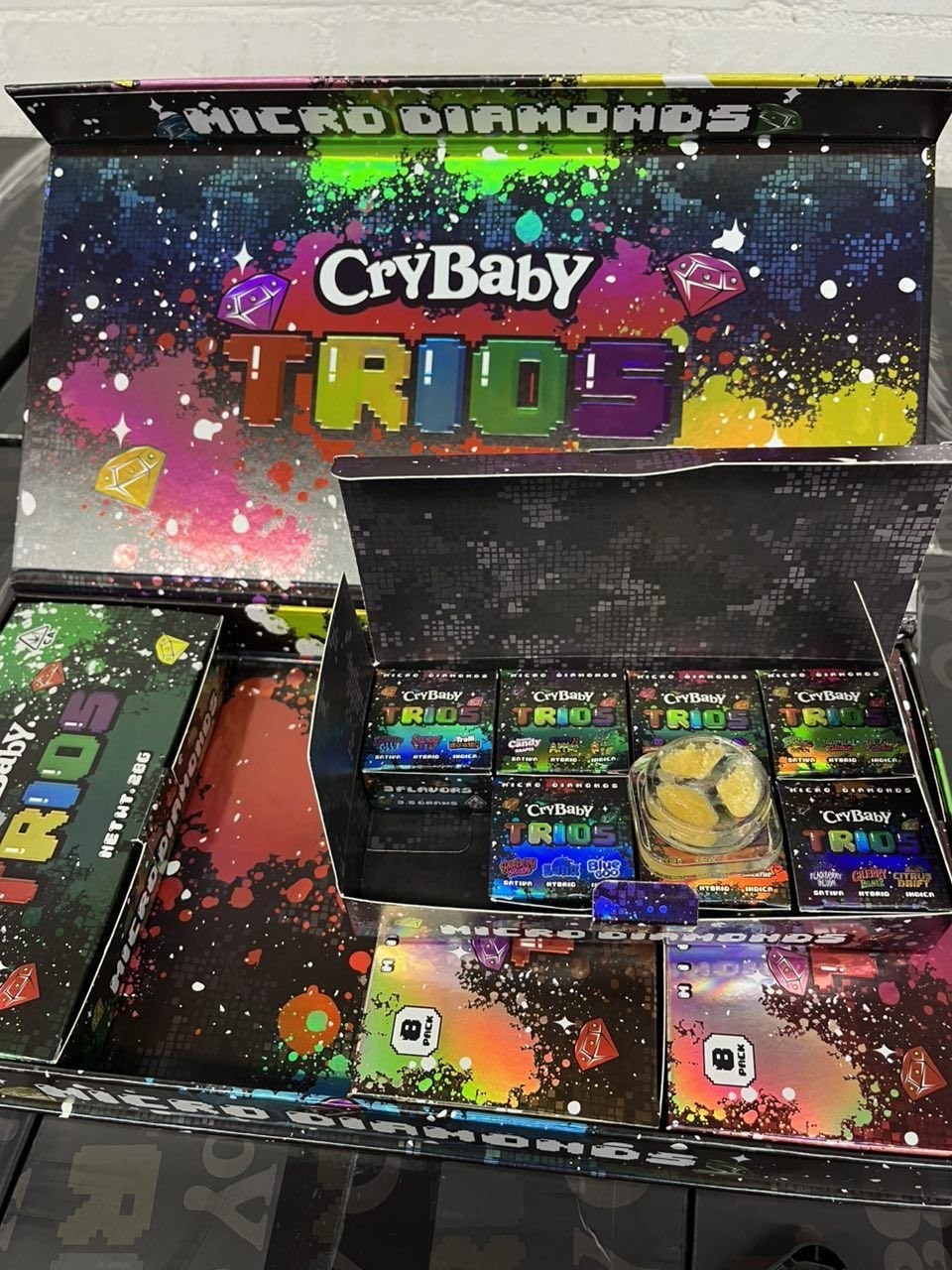

Crybaby Trios Wax Micro Diamonds 3.5g — Product Information
crybaby trios wax micro diamonds 3.5g is described as a cannabis concentrate packaged with a stated net weight of 3.5 grams. The product name identifies the concentrate as a wax-style preparation containing material described as “micro diamonds.” Because product formulations and labeling can vary between manufacturers, batches, and jurisdictions, the specific cannabinoid concentration, terpene composition, ingredients, extraction process, and other technical characteristics should be confirmed using the product’s official packaging and laboratory documentation.
The 3.5g designation refers to the stated net quantity of the packaged concentrate. It should not be interpreted as a measurement of cannabinoid content. Cannabinoid potency is normally expressed separately on compliant labeling, such as through THC and CBD concentrations or total cannabinoid quantities. Therefore, a product’s net weight alone does not establish its potency or expected effects.
Product Composition
Wax concentrates are generally concentrated cannabis preparations, although their physical appearance and consistency can differ depending on processing methods, cannabinoid composition, terpene content, temperature, and storage conditions. The term “micro diamonds” may refer to small crystalline structures associated with concentrated cannabinoids, but the exact meaning should be confirmed through the manufacturer’s documentation rather than assumed from the product name.
For an accurate listing, the following information should be taken directly from the package or certificate of analysis:
-
Net weight: 3.5g
-
THC concentration or total THC
-
CBD concentration or total CBD
-
Other cannabinoids detected during laboratory testing
-
Terpene information, when provided
-
Ingredients and additives
-
Batch or lot identification
-
Packaging date
-
Testing laboratory
-
Applicable regulatory information
-
Manufacturer or responsible-party information
-
Recommended storage conditions
These details allow consumers and retailers to distinguish verified product characteristics from assumptions based solely on the product name.
Laboratory Information
Laboratory testing can provide important information about the composition of a cannabis concentrate. Depending on the jurisdiction and regulatory framework, testing may address cannabinoid potency as well as contaminants or other quality parameters.
A certificate of analysis, commonly abbreviated as a COA, may identify the tested batch and provide measured concentrations for cannabinoids and, where applicable, information concerning pesticides, residual solvents, heavy metals, microbial contamination, mycotoxins, or other regulated substances.
The COA should correspond to the specific batch being described. Results from another product, another production run, or an unrelated batch should not be presented as though they apply to this 3.5g product.
Where laboratory information is unavailable, it is better to state that the information has not been independently verified than to supply an estimated potency or laboratory result.
Packaging and Identification
The product should remain in its original labeled packaging whenever possible. Packaging information can provide important identification details, including the product name, net quantity, batch number, cannabinoid information, manufacturer details, warnings, and regulatory markings.
For retail listings, the written description should match the physical package. Differences between the listing and the label can create confusion, particularly when several versions of a product have similar names.
The product name should also be reproduced accurately. If the packaging uses a particular capitalization, spelling, product identifier, or variant name, those details should be retained in the final listing.
Storage
Cannabis concentrates should be stored according to the manufacturer’s instructions and applicable local requirements. In general, unsuitable exposure to heat, excessive moisture, direct sunlight, or other environmental conditions can affect the physical characteristics of a concentrate.
A suitable storage location should be secure and inaccessible to children and pets. The original container and labeling should be retained so that the product can be identified and its accompanying safety information can be reviewed.
If the manufacturer provides a specific temperature range or storage recommendation, that information should take precedence over generalized storage guidance.
Handling Information
Concentrates can have different textures depending on their formulation and environmental conditions. Changes in temperature may affect consistency, appearance, or ease of handling. Consumers should follow the manufacturer’s instructions rather than relying on assumptions based solely on the product’s appearance.
The container should be closed securely after handling. Unnecessary exposure to air, heat, moisture, or contaminants should be minimized when the manufacturer’s instructions call for such precautions.
Consumers should also avoid transferring an unidentified concentrate into an unlabeled container. Maintaining the original labeling helps preserve information about the product’s identity, batch, potency, warnings, and legal status.
Potency and Individual Response
Cannabis concentrates may contain substantially concentrated amounts of cannabinoids compared with some lower-concentration cannabis preparations. For that reason, the labeled potency and applicable consumer guidance should be reviewed carefully.
Individual responses to cannabis can differ. Factors such as previous cannabis exposure, individual physiology, the presence of other substances, and the amount consumed can influence a person’s experience. Consequently, the product’s 3.5g net weight should not be presented as an indication of how a person will respond to it.
No description should guarantee a particular sensation, duration, therapeutic outcome, or level of impairment. Likewise, claims about medical benefits should not be included unless they are specifically permitted, substantiated, and appropriate for the jurisdiction in which the product is being offered.
Legal Considerations
Cannabis laws differ considerably between jurisdictions. Regulations can govern the purchase, possession, transportation, storage, sale, advertising, and consumption of cannabis concentrates.
A product that is permitted in one jurisdiction may be restricted or prohibited in another. Accordingly, consumers and businesses should verify the laws that apply to their location before purchasing, possessing, transporting, or handling the product.
Retailers should also follow applicable requirements concerning age verification, packaging, labeling, advertising, taxation, licensing, and record keeping.
Safety Information
Cannabis products should be kept away from children and pets. The product should also be stored securely to prevent unauthorized access.
Cannabis may impair attention, coordination, judgment, and reaction time. Individuals should not drive or operate machinery when impaired. Combining cannabis with alcohol or other intoxicating substances may increase impairment or produce unpredictable effects.
Anyone experiencing an unexpected or concerning reaction should seek appropriate medical assistance or contact a relevant poison-control or emergency service where appropriate.
The product should not be represented as being suitable for every consumer. Particular populations may face additional restrictions or risks, and consumers should consult a qualified healthcare professional when they have questions about cannabis and their individual circumstances.
Product Description Accuracy
For a professional product listing, accuracy is more useful than unsupported claims. Statements such as “premium,” “strongest,” “purest,” “best,” or guaranteed-effect claims should not be presented as factual unless they can be objectively substantiated and are permitted by applicable advertising rules.
Similarly, the presence of “micro diamonds” in the name does not by itself establish a specific cannabinoid percentage, extraction technique, purity level, or effect profile.
A reliable description should distinguish between what the manufacturer states, what laboratory testing establishes, and general information about cannabis concentrates.
Recommended Listing Fields
A complete product page can include a structured information section such as: crybaby trios wax micro diamonds 3.5g crybaby trios wax micro diamonds 3.5g crybaby trios wax micro diamonds 3.5g crybaby trios wax micro diamonds 3.5g crybaby trios wax micro diamonds 3.5g crybaby trios wax micro diamonds 3.5g crybaby trios wax micro diamonds 3.5g crybaby trios wax micro diamonds 3.5g crybaby trios wax micro diamonds 3.5g.
Product: Crybaby Trios Wax Micro Diamonds
Net quantity: 3.5g
Product category: Cannabis concentrate
Format: Wax / concentrate, subject to manufacturer labeling
Cannabinoid content: Verify from current package or COA
Terpene profile: Verify from current package or COA
Ingredients: Verify from current package
Batch number: See product packaging
Laboratory testing: See applicable COA
Manufacturer: See official packaging
Storage: Follow manufacturer instructions
Legal status: Subject to applicable jurisdiction
Age restrictions: Subject to applicable law
This format helps prevent unverified information from being incorporated into a product description.
Understanding the 3.5g Quantity
The “3.5g” specification identifies the stated net quantity of concentrate contained in the product package. It is a measurement of mass rather than a direct measurement of THC, CBD, or another cannabinoid.
For example, two concentrates can both have a net weight of 3.5g while having different cannabinoid concentrations. Their laboratory results may therefore differ substantially even though their package weights are identical. For this reason, product listings should display the net quantity separately from cannabinoid potency.
If the packaging provides both total cannabinoid content and concentration by weight, those figures should be reproduced exactly as labeled. Rounding or converting laboratory measurements should be avoided unless the applicable regulations specifically permit it.
Understanding “Wax”
The term “wax” generally describes the physical form or texture of a cannabis concentrate rather than establishing a particular chemical composition. Cannabis concentrates can have different textures, colors, and consistencies depending on their production and storage conditions.
Consequently, visual appearance should not be used as a substitute for laboratory testing. Color or texture alone cannot reliably establish potency, purity, freshness, cannabinoid concentration, or the presence or absence of contaminants.
A product description should therefore avoid statements suggesting that a particular appearance automatically proves superior quality or potency.
Understanding “Micro Diamonds”
“Micro diamonds” is a product descriptor that may refer to small crystalline structures within a cannabis concentrate. However, terminology can vary between manufacturers and markets.
Unless the manufacturer specifically explains the term, a retailer should not assume that it refers to a particular cannabinoid, extraction process, purity percentage, or laboratory specification.
The safest approach is to reproduce the terminology used on the official packaging and then provide any additional technical explanation only when it is supported by manufacturer documentation or a corresponding COA.
Cannabinoid Information
Cannabinoids are naturally occurring compounds found in cannabis. THC and CBD are among the cannabinoids commonly reported on cannabis-product labels, although other cannabinoids may also appear depending on the product and testing requirements.
A product description should distinguish between: crybaby trios wax micro diamonds 3.5g crybaby trios wax micro diamonds 3.5g crybaby trios wax micro diamonds 3.5g crybaby trios wax micro diamonds 3.5g crybaby trios wax micro diamonds 3.5g crybaby trios wax micro diamonds 3.5g crybaby trios wax micro diamonds 3.5g crybaby trios wax micro diamonds 3.5g crybaby trios wax micro diamonds 3.5g.
-
Total THC, where applicable
-
THC concentration
-
Total CBD
-
CBD concentration
-
Other tested cannabinoids
-
Laboratory-measured values
-
Manufacturer-declared values
These terms are not necessarily interchangeable. A professional product listing should use the terminology appearing on the applicable regulatory label or laboratory report.
If no laboratory data has been supplied, cannabinoid values should not be estimated.
Terpene Information
Terpenes are naturally occurring aromatic compounds that can contribute to the scent and flavor characteristics of cannabis. A laboratory report may identify individual terpenes and their concentrations.
If a COA provides a terpene profile, those results can be incorporated into the product information section. If no verified terpene report is available, specific terpene claims should not be added simply because a product name or strain association suggests them.
Likewise, a product description should avoid promising a particular sensory experience unless that statement is permitted and supported by reliable product information.
Batch Verification
Batch information is particularly important for regulated cannabis products. A laboratory result generally corresponds to a specific sample or batch, meaning that a COA should be matched against the identifying information printed on the product.
Before publishing a listing, a retailer can compare the batch or lot number on the package with the corresponding documentation. Other information, such as testing dates and laboratory identification, can also help establish whether the document relates to the product being described.
When documentation does not match, the discrepancy should be resolved before laboratory results are included in the listing.
Packaging Information
A compliant package may contain several categories of information. Depending on jurisdiction, this can include the product identity, net quantity, cannabinoid information, manufacturer details, batch number, warnings, dates, regulatory symbols, and instructions.
The online listing should not contradict those details.
If the package has been updated, the online description should be reviewed as well. Product names, formulations, cannabinoid concentrations, and packaging requirements can change between production runs.
Responsible Storage
Storage instructions supplied by the manufacturer should be followed. The container should remain appropriately closed and should be kept in a secure location.
The product should not be left where children, pets, or unauthorized individuals can easily access it. Original labeling should also be retained so that important product and safety information remains available.
If the package contains specific storage instructions, those instructions should be reproduced accurately rather than replaced with generic recommendations.
Transportation and Possession
Transportation requirements differ by jurisdiction. Some locations impose restrictions on where cannabis products may be transported, how they must be packaged, or how much an individual may legally possess.
Accordingly, a general product description should not claim that the product can be transported freely. Consumers should consult the laws applicable to their location before moving the product.
Businesses should likewise verify licensing and distribution requirements before offering the product for sale.
Consumer Information
Consumers should examine the product label before use and should pay particular attention to cannabinoid potency and warning information.
Because concentrates can contain relatively concentrated cannabinoid levels, assumptions based solely on the package size can be misleading. The 3.5g quantity describes the amount of concentrate, while the cannabinoid percentage or total cannabinoid quantity describes its chemical composition.
Individual responses to cannabis can also vary. No responsible product description can guarantee a specific outcome or response.
Quality-Control Considerations
Quality-control information should be based on documented evidence. Laboratory testing can provide useful information about cannabinoid content and, where applicable, certain contaminants.
However, a laboratory result should be interpreted within the context of its testing methodology, sample identification, reporting limits, and applicable regulatory standards.
A product page should therefore avoid converting a single laboratory result into broad claims such as “pure,” “safe,” or “highest quality” unless those statements are specifically supported and legally permitted.
Regulatory Compliance
Cannabis-product advertising and labeling requirements vary considerably. Some jurisdictions restrict claims concerning health benefits, effects, potency, imagery, audience targeting, or product comparisons.
For that reason, a description intended for publication should be reviewed against the rules applicable to the market where it will appear.
Particular attention should be given to age restrictions and any requirements concerning responsible-use statements, health warnings, packaging, and prohibited advertising claims.
Information for Retailers
Retailers can improve product-page accuracy by maintaining a consistent process for collecting product information. The process can begin with the physical package, followed by verification against manufacturer documentation and the applicable laboratory report.
Important discrepancies should be resolved before publication. These might include differences in net weight, cannabinoid values, batch numbers, product names, or manufacturer information.
Product pages should also be reviewed periodically because inventory can contain multiple batches with different laboratory results.
Information for Consumers
Consumers can use the product label and laboratory documentation to identify information that is specific to the product they are considering. The most relevant details may include net quantity, cannabinoid content, batch identification, testing information, ingredients, warnings, and storage instructions.
Consumers should not rely on informal descriptions or assumptions about a product when official documentation is available.
Where questions remain about the product’s contents or applicable restrictions, the manufacturer, licensed retailer, regulatory authority, or an appropriately qualified professional can provide more specific information.
Closing Description
Crybaby Trios Wax Micro Diamonds 3.5g can be described accurately as a 3.5-gram cannabis concentrate product using the terminology supplied by its manufacturer. The terms “wax” and “micro diamonds” describe the product’s stated format or characteristics, but they should not be used to infer unverified potency, purity, effects, or production methods.
For a complete and reliable listing, the product’s official label and batch-specific laboratory documentation should be used to establish its cannabinoid profile, ingredients, testing information, manufacturer details, and regulatory information.
The finished listing should keep factual product specifications separate from general cannabis information. This approach makes the description easier to understand while reducing the possibility of unsupported claims. It also gives consumers access to the information they need to identify the product and review the applicable safety and legal requirements.
Final Product Summary
Crybaby Trios Wax Micro Diamonds 3.5g is a cannabis concentrate identified by a stated 3.5-gram net quantity and a product name referencing wax and micro-diamond material. The exact characteristics of the product should be established through its current label and corresponding laboratory documentation.
Before publication, retailers or distributors should verify the product’s cannabinoid profile, ingredients, batch information, testing status, manufacturer details, and regulatory labeling. Product information should be updated whenever the manufacturer releases a new batch or changes the formulation or packaging.
Consumers should read all product labeling and warnings before handling the product and should comply with the cannabis laws applicable to their location. The concentrate should be stored securely and responsibly, particularly in households or environments where children or pets may have access.
Most importantly, the 3.5g figure describes net product quantity, not potency. Any claim concerning THC, CBD, other cannabinoids, purity, contaminants, or laboratory testing should therefore be based on verified documentation for the specific product batch rather than inferred from the product name.






Reviews
There are no reviews yet.